Research Article | | Peer-Reviewed

Association Between the Dietary Practices and the Nutrition Status of Adult Cancer Outpatients at Nyeri County Referral Hospital, Kenya; A Cross Sectional Survey

Received: 4 October 2024     Accepted: 25 October 2024     Published: 18 November 2024
Views:       Downloads:
Abstract

The global attainment of the Sustainable Development Goal 3 target 3.4 has been slow, with a notable increase in the cancer burden. Besides the normal cancer pathogenesis, 5-10% of the total cancer cases develop as a result of sub-optimal diets and other lifestyle factors and therefore, consuming a healthy diet in adequate amounts helps in prevention of the tumor itself and cancer related malnutrition. Limited evidence exists on the link between dietary practices and the nutrition status of cancer patients, and this study sought to fill this gap using analytical cross-sectional study design. Data was collected using a 24-hour recall, Food Frequency Questionnaire and Malnutrition Universal Screening Tool. The dietary patterns identified from the research were, excessive consumption of foods from the starchy foods and the fats category (65.1%) with less than half (41.9%) of the respondents not attaining the minimum daily requirements of the fruit’s servings recommended by World Health Organization (WHO). The mean energy intake of the 172 respondents was below the ESPEN Clinical guidelines recommendations. More than half (51.7%) of the respondents were at a high risk of developing malnutrition and there was a statistically significant difference between individual energy intake and the nutrition status (P<0.05) rejecting the null hypothesis that there is no significant association between the energy intake and the risk of being malnourished. Linear regression r (0.41) showed a significant (P<0.05) weak positive association between a person’s diet intake and the malnutrition risk. The analysis shows that 16.7% of the overall risk of malnutrition can be explained by the dietary intake. Assessing the dietary practices of the cancer patients, screening them for malnutrition risk and enhancing nutrition education and counselling is key in improving therapeutic care of cancer patients. A study to reveal the knowledge and attitudes of the cancer patients towards these dietary practices would make a very significant contribution to the therapeutic care of the cancer patients.

Published in International Journal of Nutrition and Food Sciences (Volume 13, Issue 6)
DOI 10.11648/j.ijnfs.20241306.11
Page(s) 239-248
Creative Commons

This is an Open Access article, distributed under the terms of the Creative Commons Attribution 4.0 International License (http://creativecommons.org/licenses/by/4.0/), which permits unrestricted use, distribution and reproduction in any medium or format, provided the original work is properly cited.

Copyright

Copyright © The Author(s), 2024. Published by Science Publishing Group

Keywords

Dietary Practices, Malnutrition Universal Screening Tool, Nutrition Status, Malnutrition Risk, 24-hour Recall

1. Introduction
Cancer incidence and mortalities remain unacceptably high and it is rated as the second leading cause of non-communicable related mortalities after the cardiovascular diseases in Kenya . Besides the normal cancer pathogenesis, a huge percent (90%) of cancers cases develop as a result of lifestyle factors such as consumption of tobacco and alcohol, high levels of physical inactivity and sub-optimal diet, with the latter contributing to 5-10% of the total cases . Research has revealed the critical role the diet plays in preventing micronutrient deficiencies, mortalities reduction and also improving the nutrition status of the cancer patients by preventing malnutrition risk . Consuming a healthy diet and in adequate amounts helps in prevention of both the tumor itself and also malnutrition among the cancer patients .
Natural polyphenols have been well studied to examine their possible health effects especially defense against oxidative stress because they contain anticancer properties . Long chain N-3 fatty acids or fish oils have been used as supplements for cancer patients on chemotherapy in order to stabilize or improve appetite . Dietary fish and marine omega-3 PUFAs have also been associated with survival of cancer patients because of their anti-inflammatory activity .
Dietary recommendations have been developed to inform cancer patients diet. A Mediterranean diet (MedDiet- a recommended cancer diet) is rich in complex carbohydrates, adequate amounts of fruits, vegetables and nuts. It also entails limited processed foods, red meats, poultry and dairy and it has been used in cancer management widely, although its uptake is still low in most countries . Other nutrients that have been associated to cancer management because of their various functions in the body is Vitamin D and selenium .
The ESPEN clinical guidelines states the Total Energy Expenditure (TEE) of a cancer patient is similar to that of a healthy individual which ranges from 25-30 kcal/kg/day. The amount of protein considered adequate for the cancer patients is 1 g/kg/day, and if possible, a cancer patient should consume 1.5 g/kg/day of proteins. Vitamins and minerals are key in management of cancer patients. There requirements are as per the RDA and there is need to supply them in adequate amounts to avoid instances of micronutrients deficiencies . Similarly, the World Health Organization (WHO) recommends a minimum of 400 g (5 servings) of fruits and vegetables in a day, adequate legumes such as beans, adequate nuts and complex carbohydrates, with less than 10% of total intake coming from free sugars . A high protein intake especially plant-based origin lowers the risks of mortalities from cancer and other non-communicable diseases. Increasing the plant protein and also replacing the animal protein with plant protein would result in a healthier population .
Malnutrition among the cancer patients remain high and the association between the dietary practices and the nutrition status of the cancer patients remain unclear. A study conducted in two hospitals in Nairobi County showed that 31% of cancer patients were malnourished, with notable increase among the patients with gastro-intestinal tumors Malnutrition has significant effects on an individual including poor health outcomes, decreased quality of life and it is also linked to negative disease prognosis . Furthermore, research shows that approximately 10-20% of cancer mortalities are due to cancer- related malnutrition and not as a result of the tumor itself . Malnutrition among cancer patients remain highly under-recognised .
The European Society for Clinical Nutrition and Metabolism (ESPEN) guidelines outlines the need for proper malnutrition screening by the healthcare provider at the first contact with the cancer patient, to detect any nutritional disturbances that could be controlled if diagnosed earlier In Kenya however, evidence shows that there still exists gaps in malnutrition recognition among cancer patients. In addition, malnutrition screening tools have been greatly under-utilized .
Despite the availability of these clinical guidelines on the dietary recommendations of the cancer patients, there is limited data to describe the dietary patterns of the cancer patients and how these practices influence their nutrition status. On this basis, this study aimed at establishing the association between the dietary practices and the nutrition status of cancer patients on chemotherapy attending Nyeri County Referral Hospital.
2. Materials and Methods
2.1. Research Design
This study employed analytical cross-sectional study design to collect all data at one point in time. Data on the sociodemographic and economic characteristics of the cancer patients was collected using a researcher administered questionnaire, data on the dietary practices was collected using a 24-hour recall and a Food Frequency Questionnaire while a Malnutrition Universal Screening Tool was used to screen the patients for the malnutrition risk. A study in Korea on assessment of iodine status among the thyroid cancer patients utilized a 24-hour recall and an FFQ to collect the dietary data, employing a cross sectional study design . In addition, A study conducted in Netherlands on determining the Malnutrition status of the hospitalized patients similarly employed an observational research design, using the Malnutrition Universal Screening tool .
2.2. Study Area
This study was done in Nyeri County Referral Hospital (NCRH) in Nyeri County, Kenya. Evidence shows that the County is experiencing a high burden of non- communicable diseases . The hospital has a bed capacity of 407 beds, providing both in- and out-patients care, serving a population of over 800,000 residents.
2.3. Sample Size Determination and Sampling Strategy
Fischer’s formula was used to estimate a sample size of 185 respondents at 95% Confidence Interval, 0.05 margins of error with an assumed malnutrition prevalence in Nyeri at 0.5 and an estimated non-response rate of 10%. The list of participants attending the clinic was used to select the sample using systematic random sampling. The first respondent was randomly selected using the table of random numbers generated from www.stattrek.com to determine the starting point. Every second respondent was systematically drawn until 185 respondents were achieved. The research team interviewed the respondents during the two days of clinic visits for a period of three weeks.
2.4. Validity and Reliability
A study on performance of the MUST in Nairobi Kenya reported a sensitivity of 83.1%, 95% CI and specificity of 85.7%, 95%CI . Pre-testing of the research instruments enhanced the validity and reliability of the research instruments and the methodology. 10% of the total sample (18 respondents) was used in pre-testing the data collection tools at Meru level 5 Hospital. Pre-testing aimed at evaluating the efficacy of the research instruments, sampling strategies and the method that the researcher had chosen for data analysis. It also aimed at enhancing the validity and reliability.
Internal consistency method was used (split half method) to indicate the degree of homogeneity of the items in the research instrument. The items on the instrument were divided into two. Reliability analysis was conducted on both sets of data and a reliability coefficient of 0.725 was generated, which is considered adequate for group studies .
2.5. Data Collection Procedure
The socio-economic and demographic characteristics of respondents’ data was collected using a researcher administered questionnaire. A Malnutrition Universal Screening Tool was used to screen the cancer patients for malnutrition. It utilizes three parameters related to each other to determine the nutrition status and thus stands as a good tool of assessing cancer-related malnutrition . It utilizes the BMI score, unplanned percent weight loss in the previous 3-6 months and the acute disease score. To determine the overall risk of malnutrition, these three values are added together. A score of 0 represents a low risk of malnutrition, a score of 1 shows medium risk while a score of 2 or more means a high risk of malnutrition . To determine the overall risk of malnutrition, the BMI score, % weight loss and the acute disorder scores were added together.
A number of dietary assessments are applicable in collecting diet related information. A prospective study in UK that aimed at assessing the dietary intake and colorectal cancer utilized a 24-hr recall and a food frequency questionnaire which are applicable in a cross-sectional study . The estimates acquired from the FFQ were used to identify dietary patterns, while the 24-hour recall was used to estimate the macro-and the micro- nutrient intakes of the cancer patients at NCRH. The food frequency questionnaire was designed guided by the National Guidelines for healthy diets and physical activity (2017) and the Nutrition assessment and counselling (NACs) user guide, (2016). Nine food groups were included, with the consumption estimated as daily or weekly, and an average number of servings indicated. The 24-hour recall was adopted from the Nutrition assessment and counselling (NACs) user guide, (2016).
2.6. Data Analysis
SPSS software version 27 was to analyze the data. Nutri-survey 2007 was used to analyze the 24-hr recall data that collected individual nutrient intake. Parametric statistical tests were performed on the data, putting into consideration the assumptions of parametric tests. Measures of association (correlations) was performed to establish the strength of relationship between variables. Pearson’s correlation and linear regression was used to investigate the relationship between the dietary intake and the nutrition status. The equation for the linear regression model was:
Y= B0 + B1X1(1)
(Where Y is a continuous dependent (nutrition status) variable B0 is constant B1 is regression coefficient and X1 is a continuous independent variable, (dietary intake)).
The statistical significance threshold was set at α=0.05 (two tailed).
3. Results
3.1. Socio-Economic and Demographic Characteristics of the Study Population
The study had a 93% response rate which is within the acceptable range . Sixty one percent were female while 39% of them were male. The mean (SD) age of the respondents was 65.9 for male and 55.8 for female. Half of the respondents survive on a monthly income of between 0-10,000 Kenyan shillings and only 2.6% of the respondents earning more than Ksh. 50,000.
Table 1. Socio-economic and demographic characteristics of the study population.

Respondent’s Characteristics

Frequency

Percent (%)

Respondents gender

N=172

Male

67

39.0

Female

105

61.0

Religion

Christianity

165

95.9

Muslim

7

4.1

Respondent’s education level

Primary

105

61.0

Secondary

50

29.1

College

16

9.3

University

1

.60

Marital Status of the respondents

Married

125

72.7

Single

31

18.0

Widowed/Deceased

16

9.3

Monthly Income

0-10,000

86

50.0

10,000-20,000

49

28.5

20,000-50,000

32

18.6

50,000-100,000

5

2.9

There was a statistically significant association between education level and the monthly income of the respondents at p<0.05 rejecting a null hypothesis that there is no association between education level and the monthly income of the respondents.
3.2. Individual Dietary Intake (24 Hour Recall)
The aim of the dietary assessment (24 hr. recall and FFQ) was to characterize the dietary patterns of the respondents. The quantified 24hr.recall allowed for the calculation of individual energy and nutrients intakes. The conversion of the household measures to meaningful weights was done using a food composition database (Nutrisurvey 2007).
The mean energy intake of the 172 respondents was 1068+- 520 Kcals, 112+- 83g of carbohydrates, 46.8+-42g of protein and 27.1+-27 g of fats. Micronutrients are key in cancer care. 30-90% of cancer patients supplement their diets with micronutrients that support antioxidative process and immune-stabilizing roles. The commonly required micronutrients for cancer care are Vitamin C, Vitamin D and selenium for the antioxidative role.
Table 2. Mean dietary intakes.

Minimum

Maximum

Mean

S. D

Energy

169.30

3283.30

1068.61

520.62639

Water

240.80

3288.00

959.365

361.86533

Protein

5.50

443.40

46.8308

42.66351

Fat

.00

154.80

27.1380

27.57125

Carbohydrate

2.20

434.50

112.922

83.49550

Dietary Fiber

3.10

68.40

20.6814

12.21267

Alcohol

.00

272.10

46.1819

77.37332

PFA

.00

102.00

9.8035

14.78217

Cholesterol

.00

1102.70

92.2727

210.72963

Vitamin A

.00

23858.30

1137.71

2846.01160

Carotene

.00

7595.60

595.959

1310.93351

Vitamin E

.00

643.50

32.0442

101.53486

Vitamin B1

.10

2942.00

278.205

646.14196

Vitamin B2

.00

5892.70

107.107

618.01408

Vitamin B6

.00

3.00

.5390

.64513

Folic Acid

.00

1213.80

187.581

239.61854

Vitamin C

.10

436.30

78.6814

79.17806

Sodium

.70

5551.00

911.995

1087.75025

Potassium

165.30

8290.50

2105.25

1083.95038

Calcium

28.00

1704.50

416.126

269.89709

Magnesium

32.00

623.70

224.268

95.84983

Phosphorus

98.00

3276.00

849.868

423.89742

Iron

1.20

41.50

10.6581

6.20451

Zinc

.90

28.30

6.2738

4.58614

3.3. Frequency Consumption of Various Foods by the Respondents (FFQ)
The starchy foods and the fats and oils category were the most consumed foods (65.1% respondents reporting to be taking them on a daily basis). Less than half (41.9%) were not attaining the minimum daily requirements of the fruit’s servings, with 2.3 % rarely consuming fruits at all. A very small percent of people (8.7%) incorporated nuts and seeds in their diets with the largest percentage consuming the minimum serving. Similarly, a small percentage (37.8%) of respondents consumed milk and milk products key in bone strengthening.
Table 3. Frequency of consumption of food from different food groups.

% FREQUENCY (N=172)

Food Group

Daily

Weekly

Rarely

Average Serving

Starchy foods

65.1

34.9

0

Large (65.1%)

Vegetables

57.6

42.4

0

Large (48.8%)

Fruits

41.9

55.8

2.3

Small (40.7%)

Legumes and pulses

60.5

37.8

1.7

Large (55.2%)

Nuts and seeds

8.7

44.2

47.1

Small (73.3%)

Meat, fish, animal protein

15.1

74.4

10.5

Small (61.1%)

Milk and milk products

37.8

43.0

19.2

Small (47.1%)

Fats and oils

65.1

27.9

7.0

Large (55.8%)

Sugar and sweets

33.1

33.7

33.1

Small (47.1%)

Condiments, spices and beverages

8.1

19.2

72.7

Small (83.7%)

Alcohol

2.3

2.9

94.8

Small (95.3%)

3.4. Malnutrition Screening of Cancer Patients Using MUST
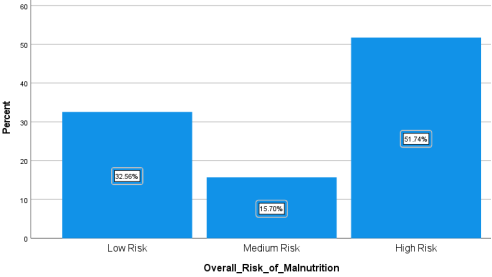
Malnutrition Universal Screening tool (MUST) was used to screen the cancer patients for malnutrition risk. More than half (51.7%) were at a high risk of developing malnutrition, followed by low risk (32.6%) with only 15.7% respondents being at a medium risk of malnutrition as shown below, figure 1.
Figure 1. Percentage risk of malnutrition for the cancer patients using MUST.
3.5. Regression Analysis Between Energy Intake and Nutrition Status of Cancer Patients
The individual energy intake was cross-tabulated with the malnutrition Universal screening tool and both were found to be statistically significant, (P<0.05) as indicated in table 4 below, rejecting the null hypothesis that there is no significant association between the energy intake and the risk of being malnourished.
Table 4. Association between individual energy intake and the Nutrition status.

R Square

B

Std. Error

Beta

Significance

.408a

.167

1.388

.157

.000

.000

.000

-.106

.167

To show the relationship between energy intake and the nutrition status, a linear regression was done between the two continuous variables. The r (0.41) showed a significant (P<0.05) weak positive relationship between dietary intake and the risk of getting malnourished. The analysis shows that only 16.7% of the overall risk of malnutrition can be explained by the dietary intake. A prediction of the overall risk of malnutrition from dietary intake can be modelled from the equation
Y= B0 + B1X1
Nutrition Status= 1.388+0.00(Dietaryintake)(2)
Where Y is a continuous dependent (nutrition status) variable B0 is constant B1 is regression coefficient and X1 is a continuous independent variable, (dietary intake).
4. Discussion
4.1. Socio-Economic and Demographic Characteristics of the Respondents
Cancer affects male and female non-selectively. More female (61%) had different types of cancer compared to male (39%), with the leading type of cancer among female being breast cancer (39%) and prostate cancer being the leading cancer type in men (11%). These findings agree with the 2020 global cancer statistics, where breast cancer surpassed the lung cancer incidence and was top of the commonly diagnosed cancers at 11.7% globally, and prostate was top leading male cancer at 7.3% However, this study reveals higher statistics compared to the global estimates, indicating that there may be gaps in the cancer reporting or that it is because this study focused on the cancer patients on chemotherapy only. The average age of the respondents was 65.9 for male and 55.8 for female. A previous study on the diagnostic assessments in various cancer centers in Kenya, found that the most frequent age for the males is 65 and females 55 similar to what this study found.
Income inequality has been increasing worldwide, education is one of the markers of financial stability and there is clear evidence that the higher the education level, the greater the chances of securing a formal employment and a higher income in response . Cancer care has been reportedly expensive and a big percent of the population requires to pay for some of the services since the National Health Insurance Fund does not comprehensively cover cancer treatment. In addition, the educated cancer patients have access to private care, improving their treatment outcomes. The significant association between education level and the monthly income of the respondents (p<0.05) was confirmed by this study. This explains why most of the respondents (61%) who had the basic primary education level had limited ability to comprehensive health care.
Most of the respondents (72.7%) were married, 18% were single while 9.3% were either divorced or widowed. A study shows that cancer survival is poorer among the unmarried compared to its counterparts who are married . Prognosis associated with cancer diagnosis is influenced by marital status. The explanation is unclear, but researchers have tried to associate this with married individuals having the ability to follow up course of therapy compared to their unmarried counterparts.
4.2. Dietary Practices of Cancer Patients
Dietary patterns of the cancer patients are very pertinent and they need to be closely monitored to prevent cancer related malnutrition . If cancer care has to attain the required standards, there is need to ensure nutrition and specifically dietary practices are monitored and the patients are guided accordingly. The American Cancer Society guidelines for a healthy diet recommends consumption of nutrient dense foods to maintain a healthy body weight for the cancer patients, consume adequate fruits and vegetables whole grains, limited use of red and processed meats, sugars and processed foods .
The mean energy intake of the 172 respondents was 1068+- 520 Kcals, 112+- 83g of carbohydrates, 46.8+-42 g of protein and 27.1+-27 g of fats. The ESPEN practical guideline recommends that the total energy expenditure of the cancer patients should be between 25-30 kg/kg/day and the mean weight of the respondents was 60.4 kgs+-13.9. From the ESPEN guidelines, the minimum energy consumption of the respondents should be 25 kcals*60.4 which gives 1510 kcals. The mean energy consumption of this population is lower than the minimum recommended energy intake of the cancer patients according to the ESPEN clinical guidelines. In addition, a cancer patient requires 1.5 g of protein per day according to the ESPEN clinical guidelines. The mean protein intake of 46.8 g was lower than the expected mean of 1.5 g *60.4 kgs(90.6 g). This can be linked to the nutrition impact symptoms such as nausea, vomiting and diarrhea, which cancer patients experience while undergoing treatment . Micronutrients are key in cancer care and evidence shows that 30-90% of cancer patients supplement their diets with micronutrients that support antioxidative process and immune-stabilizing roles. The commonly required micronutrients for cancer care are Vitamin C, Vitamin D and selenium for the antioxidative role .
Using the Food frequency questionnaire, starchy foods and the fatty foods categories were the most consumed with majority of the respondents reporting to be taking them on a daily basis. This may be because the highest percentage of the respondents (40.1%) are farmers and mostly the starchy foods are readily available. However, this poses nutritional risks to them. The non-communicable diseases risk factors are similar, the main one being obesity and diets rich in fats and starches. Obesity pathophysiology is also linked to fat deposition associated with excessive intake of fats and carbohydrates . Whole grains for cancer care increase the bulkiness of stool. Bulky stools have an increased transit time which reduces the interaction between carcinogenic substances with normal cells. It also limits the bacterial endotoxins which damages the cells from being absorbed. The whole grains are rich in fiber. During the digestion process, fiber breaks down into short chain fatty acids which are a source of energy that the cancer cells have the inability to utilize. This lowers the growth and development of the cancer cells
Less than half (41.9%) were not attaining the minimum daily requirements of the fruit’s servings, with 2.3 % rarely consuming fruits at all. The WHO recommends of 3-5 servings of fruits and vegetables per week which was not being met by 41.9% of the respondents. Fruits and vegetables are associated with antioxidants that are so important in management of cancer. The anti-oxidant properties of flavonoids, Vitamin C and E and carotenoids are mostly found in fruits and the dark green vegetables. A very small percent of people (8.7%) incorporated nuts and seeds in their diets with the largest percentage consuming the minimum serving. Nuts and seeds are important sources of poly-unsaturated fatty acids, and specifically omega 3 and omega 6 fatty acids. Omega 3 fatty acids have been associated with reduction in inflammation, reduced angiogenesis, and metastasis and reduced proliferation of cells .
A small percentage (37.8%) of respondents consumed milk and milk products, which are very high sources of calcium, key in bone strengthening. One of the common problems associated with chemotherapy treatment in cancer care is bone loss. Chemotherapy drugs such as doxorubicin and cisplatin reduce calcium levels in the body, leading to body loss . This must be supplied in adequate amounts together with Vitamin D rich foods because optimal levels of Vitamin D are necessary to enhance calcium absorption. This study reveals that a small percentage of the respondents consumed foods from the fish and meats categories, which is the main dietary source of Vitamin D.
4.3. Malnutrition Risk of Cancer Patients
More than half of the respondents (51.7%) were at a high risk of developing malnutrition, followed by low risk (32.6%) with only 15.7% respondents being at a medium risk of malnutrition. Using the BMI, half of the respondents, (50%) had a normal nutrition status and only 19.8% respondents were underweight. Body Mass Index has been greatly used as an indicator for the nutrition status in a healthy population, but it tends to under-estimate weight loss in patients with chronic illnesses . The utilization of MUST is becoming popular because of its good validity and reliability. MUST utilizes three components, the BMI-Score, unplanned weight loss for the last 6 months and the acute disease score. High risks of malnutrition have been significantly associated with mortality, (HR=3.9; 95%CI, p=0.02) . The malnutrition screening tools have been greatly under-utilized despite the fact that they can predict malnutrition early, and improve the treatment outcome . A significant difference was found between classifying the nutrition status using BMI and Malnutrition Universal screening tool and this justifies the reason why adoption of more than one tool in determining malnutrition in cancer patients is recommended.
4.4. Association Between Dietary Practices and the Nutrition Status of Cancer Outpatients
A linear regression showed a significant positive relationship between the dietary practices and the nutrition status of the respondents with 16.7% of the overall risk of malnutrition being explained by the dietary intake. A study conducted at Texas Cancer Centre in Nairobi revealed similar findings, using adjusted odds ratio (AOR=0.55; CI, 0.15-1.13; p- value= 0.032) . Evidence shows the critical role diet plays in preventing micronutrient deficiencies, mortalities reduction and also improving the nutrition status of the cancer patients by preventing malnutrition risk . Consuming a healthy diet and in adequate amounts helps in prevention of both the tumor itself and also malnutrition among the cancer patients .
5. Conclusions
Evidence shows that 5-10% of the cancer cases develop as a result of sub-optimal diets and malnutrition affects 85% of cancer patients. This study reveals inappropriate dietary practices among cancer patients and dietary intake that doesn’t meet the ESPEN and WHO dietary recommendations. Dietary intake is a key indicator of the nutrition status. This study revealed a clear weak positive correlation between the dietary practices and nutrition status of the cancer patients with more than half of the respondents being at a high risk of developing malnutrition.
6. Recommendations
Dietary assessment of cancer patients coupled with regular malnutrition screening using the Malnutrition Universal Screening tool can be adopted in the health facilities to improve therapeutic care of cancer patients. 24-hour recall, Food Frequency Questionnaire and a Malnutrition Universal Screening Tool are easy to use and are applicable in a hospital setting.
With the inappropriate dietary practices revealed by this study, further investigations on the knowledge and attitudes of the cancer patients towards these dietary practices would make a very significant contribution to the therapeutic care of the cancer patients. Social and Behaviour Change strategies can be adopted to increase the knowledge and attitudes of cancer patients towards the recommended dietary practices to improve their nutrition and health outcomes.
Abbreviations

ESPEN

European Society for Clinical Nutrition and Metabolism

FFQ

Food Frequency Questionnaire

MUST

Malnutrition Universal Screening Tool

BMI

Body Mass Index

NCRH

Nyeri County Referral Hospital

Acknowledgments
I would like to appreciate the support from the Department of Health at Nyeri County during this research. In addition, special appreciation goes to the staff at the oncology department in Nyeri County Referral Hospital for the support in data collection.
Author Contributions
Dorothy Bundi: Conceptualization, Formal Analysis, Investigation, Methodology, Project administration, Software, Writing – original draft, Writing – review & editing
Peter Chege: Conceptualization, Supervision, Writing – review & editing
Regina Kamuhu: Supervision, Writing – review & editing
Funding
This work is not supported by any external funding
Data Availability Statement
The data supporting the outcome of this research work has been reported in this manuscript.
Conflicts of Interest
The authors declare no conflicts of interest.
References
[1] Sung H, Ferlay J, Siegel RL, Laversanne M, Soerjomataram I, Jemal A, et al. Global Cancer Statistics 2020: GLOBOCAN Estimates of Incidence and Mortality Worldwide for 36 Cancers in 185 Countries. CA Cancer JClin2021; 71: 209–49.
[2] Morze J, Danielewicz A, Przybyłowicz K, Zeng H, Hoffmann G, Schwingshackl L. An updated systematic review and meta-analysis on adherence to mediterranean diet and risk of cancer. Eur J Nutr 2021; 60: 1561–86.
[3] Muscaritoli M, Arends J, Bachmann P, Baracos V, Barthelemy N, Bertz H, et al. ESPEN practical guideline: Clinical Nutrition in cancer. Clin Nutr 2021; 40: 2898–913.
[4] Wang Y, Liu K, Long T, Long J, Li Y, Li J, et al. Dietary fish and omega-3 polyunsaturated fatty acids intake and cancer survival: A systematic review and meta-analysis. Crit Rev Food Sci Nutr 2023; 63: 6235–51.
[5] Naghshi S, Sadeghi O, Willett WC, Esmaillzadeh A. Dietary intake of total, animal, and plant proteins and risk of all cause, cardiovascular, and cancer mortality: Systematic review and dose-response meta-analysis of prospective cohort studies. The BMJ 2020; 370.
[6] Ministry of Health Kenya. National Guidelines for Healthy Diets. Natl Guidel Healthy Diets Phys Act 2017.
[7] American Cancer Society. Nutrition for People with Cancer Benefits of good nutrition during cancer treatment 2018: 1–27.
[8] Bhosale PB, Ha SE, Vetrivel P, Kim HH, Kim SM, Kim GS. Functions of polyphenols and its anticancer properties in biomedical research: A narrative review. Transl Cancer Res 2020; 9: 7619–31.
[9] Radomska D, Czarnomysy R, Radomski D, Bielawska A, Bielawski K. Selenium as a bioactive micronutrient in the human diet and its cancer chemopreventive activity. Nutrients 2021; 13: 1–25.
[10] Opanga Y, Kaduka L, Bukania Z, Mutisya R, Korir A, Thuita V, et al. Nutritional status of cancer outpatients using scored patient generated subjective global assessment in two cancer treatment centers, Nairobi, Kenya. BMC Nutr 2017; 3: 1–7.
[11] Sissung TM, Cordes LM, Figg WD. Perspectives Quackery the Dietary Supplement Health and Education Act: are we healthier and better informed after 27 years? Lancet Oncol 2021; 22: 915–6.
[12] Muscaritoli M, Lucia S, Farcomeni A, Lorusso V, Saracino V, Barone C, et al. Prevalence of malnutrition in patients at first medical oncology visit: The PreMiO study. Oncotarget 2017; 8: 79884–96.
[13] Choi JY, Lee JH, Song YJ. Evaluation of Iodine Status among Korean Patients with Papillary Thyroid Cancer Using Dietary and Urinary Iodine. Endocrinol Metab 2021; 36: 607–18.
[14] Gomes-Neto AW, Vliet IMY van, Osté MCJ, Jong MFC de, Bakker SJL, Jager-Wittenaar H, et al. Malnutrition Universal Screening Tool and Patient-Generated Subjective Global Assessment Short Form and their predictive validity in hospitalized patients. Clin Nutr ESPEN 2021; 45: 252–61.
[15] Wambalaba FW, Son B, Wambalaba AE, Nyong’o D, Nyong’o A. Prevalence and Capacity of Cancer Diagnostics and Treatment: A Demand and Supply Survey of Health-Care Facilities in Kenya. Cancer Control 2019; 26: 1–12.
[16] NCIDP 2013-2017. Republic of Kenya Nyeri County Intergrated Development Plan 2013-2017 Department of Finance and Economic Planning 2013: 324.
[17] Sun Y, Phillips PCB. Understanding the Fisher equation. J Appl Econom 2004; 19: 869–86.
[18] Auma CMN, Mweu MM, Opiyo RO. Performance of Malnutrition Universal Screening Tool and Patient-Generated Global Subjective Assessment in screening for cancer-related malnutrition in Nairobi, Kenya. F1000Research 2022; 11: 755.
[19] Danner D. Reliability – The Precision of a Measurement. GESIS Surv Guidel 2016.
[20] Laky B, Janda M, Kondalsamy-Chennakesavan S, Cleghorn G, Obermair A. Pretreatment malnutrition and quality of life - association with prolonged length of hospital stay among patients with gynecological cancer: A cohort study. BMC Cancer 2010; 10.
[21] Bradbury KE, Murphy N, Key TJ. Diet and colorectal cancer in UK Biobank: A prospective study. Int J Epidemiol 2020; 49: 246–58.
[22] Thompson FE, Subar AF. Dietary Assessment Methodology. 2017.
[23] Fincham JE. Response rates and responsiveness for surveys, standards, and the Journal. Am J Pharm Educ 2008; 72: 43.
[24] Hinata A, Kabasawa K, Watanabe Y, Kitamura K, Ito Y, Takachi R, et al. Education, household income, and depressive symptoms in middle-aged and older Japanese adults. BMC Public Health 2021; 21: 1–10.
[25] Krajc K, Miroševič Š, Sajovic J, Klemenc Ketiš Z, Spiegel D, Drevenšek G, et al. Marital status and survival in cancer patients: A systematic review and meta‐analysis. Cancer Med 2023; 12: 1685–708.
[26] Rock CL, Thomson C, Gansler T, Gapstur SM, Mccullough ML, Patel AV, et al. American Cancer Society Guideline for Diet and Physical Activity for Cancer Prevention 2020; 70: 245–71.
[27] de Pinho NB, Martucci RB, Rodrigues VD, D’Almeida CA, Thuler LCS, Saunders C, et al. Malnutrition associated with nutrition impact symptoms and localization of the disease: Results of a multicentric research on oncological nutrition. Clin Nutr 2019; 38: 1274–9.
[28] Lega IC, Lipscombe LL. Review: Diabetes, Obesity, and Cancer-Pathophysiology and Clinical Implications. Endocr Rev 2020; 41: 33–52.
[29] Nagy S, Petrosky SN, Beckler MD, Kesselman MM. The Impact of Modern Dietary Practices on Cancer Risk and Progression: A Systematic Review. Cureus 2023.
[30] Hanson S, Thorpe G, Winstanley L, Abdelhamid AS, Hooper L, Abdelhamid A, et al. Omega-3, omega-6 and total dietary polyunsaturated fat on cancer incidence: systematic review and meta-analysis of randomised trials. Br J Cancer 2020; 122: 1260–70.
[31] Anderson NM, Simon MC. The tumor microenvironment. Curr Biol 2020; 30: R921–5.
[32] Oduor EA, Odongo AO, Kiboi W. Dietary Practices and Nutritional Status of Adult Cancer Patients: A Case Study of Texas Cancer Center, Kenya. Int J Trop Dis Health 2024; 45: 36–44.
Cite This Article
  • APA Style

    Bundi, D., Chege, P., Kamuhu, R. (2024). Association Between the Dietary Practices and the Nutrition Status of Adult Cancer Outpatients at Nyeri County Referral Hospital, Kenya; A Cross Sectional Survey. International Journal of Nutrition and Food Sciences, 13(6), 239-248. https://doi.org/10.11648/j.ijnfs.20241306.11

    Copy | Download

    ACS Style

    Bundi, D.; Chege, P.; Kamuhu, R. Association Between the Dietary Practices and the Nutrition Status of Adult Cancer Outpatients at Nyeri County Referral Hospital, Kenya; A Cross Sectional Survey. Int. J. Nutr. Food Sci. 2024, 13(6), 239-248. doi: 10.11648/j.ijnfs.20241306.11

    Copy | Download

    AMA Style

    Bundi D, Chege P, Kamuhu R. Association Between the Dietary Practices and the Nutrition Status of Adult Cancer Outpatients at Nyeri County Referral Hospital, Kenya; A Cross Sectional Survey. Int J Nutr Food Sci. 2024;13(6):239-248. doi: 10.11648/j.ijnfs.20241306.11

    Copy | Download

  • @article{10.11648/j.ijnfs.20241306.11,
      author = {Dorothy Bundi and Peter Chege and Regina Kamuhu},
      title = {Association Between the Dietary Practices and the Nutrition Status of Adult Cancer Outpatients at Nyeri County Referral Hospital, Kenya; A Cross Sectional Survey
    },
      journal = {International Journal of Nutrition and Food Sciences},
      volume = {13},
      number = {6},
      pages = {239-248},
      doi = {10.11648/j.ijnfs.20241306.11},
      url = {https://doi.org/10.11648/j.ijnfs.20241306.11},
      eprint = {https://article.sciencepublishinggroup.com/pdf/10.11648.j.ijnfs.20241306.11},
      abstract = {The global attainment of the Sustainable Development Goal 3 target 3.4 has been slow, with a notable increase in the cancer burden. Besides the normal cancer pathogenesis, 5-10% of the total cancer cases develop as a result of sub-optimal diets and other lifestyle factors and therefore, consuming a healthy diet in adequate amounts helps in prevention of the tumor itself and cancer related malnutrition. Limited evidence exists on the link between dietary practices and the nutrition status of cancer patients, and this study sought to fill this gap using analytical cross-sectional study design. Data was collected using a 24-hour recall, Food Frequency Questionnaire and Malnutrition Universal Screening Tool. The dietary patterns identified from the research were, excessive consumption of foods from the starchy foods and the fats category (65.1%) with less than half (41.9%) of the respondents not attaining the minimum daily requirements of the fruit’s servings recommended by World Health Organization (WHO). The mean energy intake of the 172 respondents was below the ESPEN Clinical guidelines recommendations. More than half (51.7%) of the respondents were at a high risk of developing malnutrition and there was a statistically significant difference between individual energy intake and the nutrition status (P<0.05) rejecting the null hypothesis that there is no significant association between the energy intake and the risk of being malnourished. Linear regression r (0.41) showed a significant (P<0.05) weak positive association between a person’s diet intake and the malnutrition risk. The analysis shows that 16.7% of the overall risk of malnutrition can be explained by the dietary intake. Assessing the dietary practices of the cancer patients, screening them for malnutrition risk and enhancing nutrition education and counselling is key in improving therapeutic care of cancer patients. A study to reveal the knowledge and attitudes of the cancer patients towards these dietary practices would make a very significant contribution to the therapeutic care of the cancer patients.
    },
     year = {2024}
    }
    

    Copy | Download

  • TY  - JOUR
    T1  - Association Between the Dietary Practices and the Nutrition Status of Adult Cancer Outpatients at Nyeri County Referral Hospital, Kenya; A Cross Sectional Survey
    
    AU  - Dorothy Bundi
    AU  - Peter Chege
    AU  - Regina Kamuhu
    Y1  - 2024/11/18
    PY  - 2024
    N1  - https://doi.org/10.11648/j.ijnfs.20241306.11
    DO  - 10.11648/j.ijnfs.20241306.11
    T2  - International Journal of Nutrition and Food Sciences
    JF  - International Journal of Nutrition and Food Sciences
    JO  - International Journal of Nutrition and Food Sciences
    SP  - 239
    EP  - 248
    PB  - Science Publishing Group
    SN  - 2327-2716
    UR  - https://doi.org/10.11648/j.ijnfs.20241306.11
    AB  - The global attainment of the Sustainable Development Goal 3 target 3.4 has been slow, with a notable increase in the cancer burden. Besides the normal cancer pathogenesis, 5-10% of the total cancer cases develop as a result of sub-optimal diets and other lifestyle factors and therefore, consuming a healthy diet in adequate amounts helps in prevention of the tumor itself and cancer related malnutrition. Limited evidence exists on the link between dietary practices and the nutrition status of cancer patients, and this study sought to fill this gap using analytical cross-sectional study design. Data was collected using a 24-hour recall, Food Frequency Questionnaire and Malnutrition Universal Screening Tool. The dietary patterns identified from the research were, excessive consumption of foods from the starchy foods and the fats category (65.1%) with less than half (41.9%) of the respondents not attaining the minimum daily requirements of the fruit’s servings recommended by World Health Organization (WHO). The mean energy intake of the 172 respondents was below the ESPEN Clinical guidelines recommendations. More than half (51.7%) of the respondents were at a high risk of developing malnutrition and there was a statistically significant difference between individual energy intake and the nutrition status (P<0.05) rejecting the null hypothesis that there is no significant association between the energy intake and the risk of being malnourished. Linear regression r (0.41) showed a significant (P<0.05) weak positive association between a person’s diet intake and the malnutrition risk. The analysis shows that 16.7% of the overall risk of malnutrition can be explained by the dietary intake. Assessing the dietary practices of the cancer patients, screening them for malnutrition risk and enhancing nutrition education and counselling is key in improving therapeutic care of cancer patients. A study to reveal the knowledge and attitudes of the cancer patients towards these dietary practices would make a very significant contribution to the therapeutic care of the cancer patients.
    
    VL  - 13
    IS  - 6
    ER  - 

    Copy | Download

Author Information
  • Institute of Food Bioresources Technology, Dedan Kimathi University of Technology, Nyeri, Kenya

    Biography: Dorothy Kareainto Bundi is a Nutrition technologist at Dedan Kimathi University of Technology. She is a master’s student at Kenyatta University and holds a Bachelor’s degree from Egerton University, (2015).

    Research Fields: Non-communicable Diseases and nutrition, Maternal and Child Nutrition.

  • School of Health Sciences, Kenyatta University, Nairobi, Kenya

    Biography: Peter Chege is a senior lecturer at Kenyatta University. He holds a PhD and a Masters degree from Kenyatta University.

    Research Fields: Agri-nutrition, Community nutrition, Food security, Micronutrients, Livelihood studies

  • School of Health Sciences, Kenyatta University, Nairobi, Kenya

    Biography: Regina Kamuhu Is a lecturer at Kenyatta University Department of Foods, Nutrition and Dietetics. She holds a PhD in Foods, Nutrition and Dietetics from Kenyatta University- 2016 and a Master’s degree from University of Panjab, India.

    Research Fields: HIV dyslipidaemia, Utilization of groundnuts/ peanut in treatment of lipid disorders in HIV and diabetes.


  • Abstract
  • Keywords
  • Document Sections

    1. 1. Introduction
    2. 2. Materials and Methods
    3. 3. Results
    4. 4. Discussion
    5. 5. Conclusions
    6. 6. Recommendations
    Show Full Outline
  • Abbreviations
  • Acknowledgments
  • Author Contributions
  • Funding
  • Data Availability Statement
  • Conflicts of Interest
  • References
  • Cite This Article
  • Author Information