Research Article | | Peer-Reviewed

Contribution of Women in the Adoption of Organic Fertilizers Among Smallholder Maize Farmers in Bugangari Sub-County, Rukungiri District

Received: 12 May 2026     Accepted: 21 May 2026     Published: 30 May 2026
Views:       Downloads:
Abstract

Agriculture remains a central pillar of rural livelihoods, with smallholder farmers playing a key role in food production and household income. In many developing regions, women constitute a significant proportion of the agricultural labor force, yet their contributions often remain under recognized. The promotion of sustainable farming practices, such as the use of organic fertilizers, has gained attention due to their environmental and productivity benefits. However, gender-related constraints continue to influence the adoption and effective utilization of such innovations. The study was about the contribution of women in the adoption of organic fertilizers among Smallholder maize farmers in Bugangari Sub-County, Rukungiri District. The specific objectives included to; evaluate the role of women in adopting organic fertilizers on maize productivity, assess the challenges faced by women in the adoption of organic fertilizers, and suggest strategies for enhancing women’s contribution and adoption of organic fertilizers. The study adopted a mixed-methods approach that integrated both descriptive and cross-sectional survey designs employing both qualitative and quantitative approaches to data collection and analysis. Data was gathered from 201 smallholder maize farmers and key informants using both questionnaire and interviews. Data was managed and analyzed using SPSS version 20 to generate both descriptive and regression statistics. The study found out that women play a critical role in the adoption of organic fertilizers among smallholder maize farmers in Bugangari Sub-County. Their contributions span several areas including fertilizer preparation (16.9%), field application (15.4%), farm management (13.9%), labor provision (12.9%), and knowledge sharing (8.5%). Hese challenges include inadequate extension services (B = -1.284, p = 0.002), limited land ownership (B = -0.965, p = 0.009), lack of information (B = -1.133, p = 0.004), poor access to organic inputs (B = -0.847, p = 0.014), high costs (B = -1.056, p = 0.005), limited access to credit (B = -0.918, p = 0.011), and restrictive cultural norms (B = -0.774, p = 0.022). The study concluded that women played a vital role in the adoption of organic fertilizers among smallholder maize farmers in Bugangari Sub-County through activities such as fertilizer preparation, field application, farm management, labor provision, and knowledge sharing. The study recommends improving women’s financial access, knowledge, and institutional support since it is essential for increasing adoption levels.

Published in International Journal of Nutrition and Food Sciences (Volume 15, Issue 3)
DOI 10.11648/j.ijnfs.20261503.13
Page(s) 112-121
Creative Commons

This is an Open Access article, distributed under the terms of the Creative Commons Attribution 4.0 International License (http://creativecommons.org/licenses/by/4.0/), which permits unrestricted use, distribution and reproduction in any medium or format, provided the original work is properly cited.

Copyright

Copyright © The Author(s), 2026. Published by Science Publishing Group

Keywords

Women Adoption of Organic Fertilizers, Smallholder Maize Farmers, Bugangari, Rukungiri, Uganda

1. Introduction
Women farmers play a pivotal role in advancing sustainable agriculture globally, particularly in the adoption of organic fertilizers in smallholder maize systems. They constitute about 43% of the global agricultural labor force and are central to food security and soil management Their involvement has increased due to concerns over soil degradation and environmental sustainability . Their hands-on role in composting and soil management positions them as key drivers of organic fertilizer adoption .
In developed regions such as the United States, Germany, and France, women farmers lead in adopting organic fertilizers like cattle manure and poultry droppings to improve soil fertility . These practices enhance soil structure, nutrient cycling, and reduce dependence on synthetic inputs . In countries like France, fermented manure improves microbial activity and supports ecological farming . This reflects women’s commitment to both productivity and environmental sustainability .
In developing regions such as South Asia and Latin America, women rely on livestock manure due to limited access to inorganic fertilizers. They combine cow dung with crop residues to produce compost that sustains maize yields . Similar practices are observed in Japan and Mexico, where women use organic materials to maintain soil fertility and preserve indigenous knowledge . These approaches highlight their role in promoting cost-effective and sustainable farming .
In Africa, women contribute nearly 70% of food production, especially maize, and play a central role in organic soil fertility management . However, their adoption of organic fertilizers is constrained by high input costs, limited extension services, and land challenges . Despite this, they widely use manure and compost to improve soil productivity . Support from cooperatives and programs in countries like Nigeria and Ethiopia has strengthened their capacity to innovate .
In East Africa, particularly Uganda, women are key actors in organic fertilizer adoption and innovation in maize farming. They utilize locally available materials such as manure, crop residues, and biochar to enhance soil fertility . Support from govern.ments and NGOs has enhanced training and cooperative efforts . In areas like Bugangari Sub-County, women actively adopt and disseminate organic farming knowledge, contributing to sustainable agriculture .
2. Problem Statement
Sustainable farming practices, particularly the use of organic fertilizers, are increasingly recognized as vital for improving soil fertility, crop productivity, and environmental sustainability. Overreliance on chemical fertilizers has led to soil degradation and declining yields in sub-Saharan Africa, making organic inputs a key alternative . In Uganda, maize remains a staple crop, and practices such as composting and manure application are essential for soil health . However, although women contribute nearly 70% of agricultural labor, their access to resources and decision-making remains limited . Despite the benefits of organic fertilizers, their adoption among smallholder farmers remains low, with only about 22% using organic inputs compared to 68% relying on inorganic fertilizers . Gender disparities persist, as women farmers face constraints in accessing knowledge, labor, and financial resources necessary for adoption . In Western Uganda, including Rukungiri District, adoption levels are below 20%, with women forming the majority of non-adopters due to limited access to training and inputs . Evidence from Bugangari Sub-County further suggests particularly low uptake, highlighting the need for localized investigation . Although initiatives by government and organizations such as NOGAMU and Caritas Uganda aim to promote sustainable farming, their impact remains uneven, especially in marginalized areas like Bugangari . Gender-specific barriers, including limited extension services, restrictive cultural norms, and weak input supply systems, continue to hinder women’s adoption of organic fertilizers . Therefore, this study sought to address these gaps by evaluating the role of women in adopting organic fertilizers on maize productivity and assessing the challenges they face, in order to enhance gender-responsive and sustainable agricultural practices.
3. Conceptual Framework
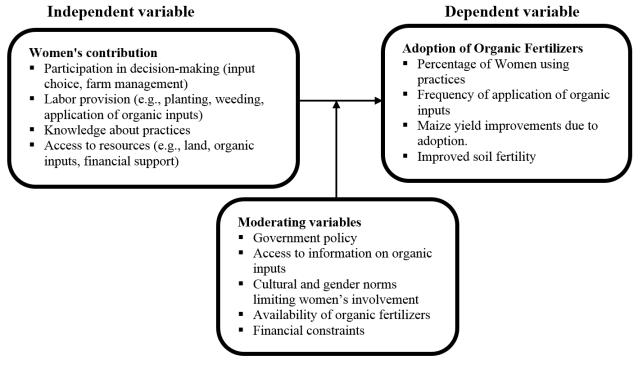
The study looked at women’s contribution as the independent variable and adoption of organic fertilizers as the dependent variable. The framework demonstrated a set of relationships among background variables, independent variables and dependent variables.
The conceptual framework for this study positioned women’s contribution as the independent variable influencing the adoption of organic fertilizers as the dependent variable. It assumes that women’s roles in agriculture such as decision-making, labor provision, knowledge of sustainable practices, and access to productive resources directly shaped the likelihood and extent to which organic fertilizers are adopted. When women actively participate in farm management and possess adequate knowledge and resources, they are more inclined to embrace environmentally sustainable soil management practices. The framework further illustrates that this relationship is not isolated but operates within a broader context of background variables such as socio-economic status, education level, cultural norms, and access to extension services. These factors can either facilitate or constrain both women’s contributions and the adoption process. Therefore, the adoption of organic fertilizers is understood as an outcome of the interaction between women’s active involvement in agriculture and the enabling or limiting conditions presented by these background variables.
Source: Researcher’s own construct, 2026

Download: Download full-size image

Figure 1. A conceptual frame work describing the relationship between women’s contribution and adoption of organic fertilizers in maize production.
4. Materials and Methods
The study adopted a mixed-methods approach integrating descriptive and cross-sectional survey designs to collect both qualitative and quantitative data. The descriptive design captured women’s roles and experiences, while the cross-sectional design enabled data collection at a single point in time. This combination enhanced understanding of both the extent and nature of women’s participation in organic fertilizer adoption. It also improved the reliability and validity of the study findings.
The study was conducted in Bugangari Sub-County, Rukungiri District in southwestern Uganda, an area characterized by fertile soils, favorable climate, and subsistence farming. Agriculture is the main economic activity, with maize as a key crop alongside livestock keeping. However, the area faces challenges such as declining soil fertility, climate variability, and limited extension services. These conditions provided a suitable context for examining organic fertilizer adoption among smallholder farmers.
The study population comprised smallholder maize farmers, local leaders, and agricultural extension agents. A sample size of 201 respondents was determined using the formula. Simple random sampling was used to select farmers, while purposive sampling identified key informants with relevant knowledge. This ensured representation, minimized bias, and provided in-depth insights into the study variables.
Data was collected using semi-structured questionnaires and interview guides administered through face-to-face interactions. Questionnaires included both open-ended and closed-ended questions, while interviews targeted key informants for deeper insights. Instruments were translated into the local language to enhance understanding and accuracy. Validity and reliability were ensured through expert review, pilot testing, and statistical measures such as Cronbach’s alpha.
Data was analyzed using both qualitative and quantitative techniques, with SPSS version 23 employed for statistical analysis. Descriptive statistics, correlations, and regression were used to examine relationships between variables, while qualitative data was analyzed through content analysis. Ethical considerations such as informed consent, confidentiality, and voluntary participation were strictly observed. These procedures ensured credible, reliable, and ethically sound research findings.
5. Results
Table 1. Socio-economic characteristics of farmers.

Socio-economic characteristics of farmers

Total (n=201)

Gender (%)

Male

87 (43.3%)

Female

114 (56.7%)

Age bracket (%)

0–30

38 (18.9%)

30–40

64 (31.8%)

40–50

55 (27.4%)

51 and above

44 (21.9%)

Marital status (%)

Single

35 (17.4%)

Married

118 (58.7%)

Widow/Widower

29 (14.4%)

Separated/Divorced

19 (9.5%)

Education level of respondents (%)

No formal education

29 (14.4%)

Primary education

92 (45.8%)

Secondary education

60 (29.9%)

Tertiary education

20 (9.9%)

Household size (%)

1–3 members

37 (18.4%)

4–6 members

96 (47.8%)

7–9 members

46 (22.9%)

10 and above

22 (10.9%)

Farm size (%)

Less than 1 acre

42 (20.9%)

1–2 acres

88 (43.8%)

3–4 acres

49 (24.4%)

5 acres and above

22 (10.9%)

Farming Experience (Years)

Less than 5 years

29 (14.4%)

5–10 years

58 (28.9%)

11–20 years

72 (35.8%)

Above 20 years

42 (20.9%)

Results in Table 1 shows that majority of respondents were female. Out of the 201 respondents who participated in the study, 114 (56.7%) were women, while 87 (43.3%) were men. Women constituted a larger proportion of the study and their dominance was reflected on the significant role they play in agricultural production and decision-making processes related to the adoption of organic fertilizers.
Respondents belonged to different age categories. The majority of respondents, 64 (31.8%), were aged between 30–40 years, followed by 55 (27.4%) who were between 40–50 years. Respondents aged 51 years and above constituted 44 (21.9%), while the least represented group was those aged 0–30 years, accounting for 38 (18.9%). Most respondents were within the economically active and productive age groups. Individuals aged between 30 and 50 years were more actively involved in farming activities and household food production.
Married respondents accounted for 118 (58.7%) of the total sample. The single constituted 35 (17.4%), while 29 (14.4%) were widowed. Those who were separated or divorced accounted for 19 (9.5%) of the respondents. The high proportion of married respondents suggested that maize farming in Bugangari is largely practiced within family households.
Respondents had varying levels of educational attainment with the largest proportion 92 (45.8%), having attained primary education, followed by 60 (29.9%) who had completed secondary education. Respondents with no formal education accounted for 29 (14.4%), while 20 (9.9%) had attained tertiary education. This presentation reveals that majority of maize farmers in the study area possessed at least basic literacy skills acquired through primary or secondary education. Such educational levels facilitated the understanding of agricultural extension messages related to soil fertility management and organic fertilizer technologies.
Respondents had varying household sizes with majority 96 (47.8%), who reported having 4–6 household members, followed by 46 (22.9%) who had 7–9 members in their households. Respondents with 1–3 household members accounted for 37 (18.4%), while 22 (10.9%) reported households with 10 or more members. Most households consisted of moderate family sizes, which provide adequate family labor for farming activities.
Majority of respondents were smallholder farmers with relatively small land holdings. The largest proportion, 88 (43.8%), owned 1–2 acres of farmland, followed by 49 (24.4%) who owned 3–4 acres. Respondents with less than one acre constituted 42 (20.9%), while only 22 (10.9%) owned five acres or more. These results confirmed that agriculture is largely dominated by small-scale farming systems.
Results further shows that majority of respondents, 72 (35.8%), had 11–20 years of farming experience, followed by 58 (28.9%) who had farmed for 5–10 years. Respondents with more than 20 years of farming experience accounted for 42 (20.9%), while 29 (14.4%) had farmed for less than five years. Most respondents had considerable farming experience, which positively influenced their knowledge of soil fertility management practices.
Table 2. Women’s contribution to the adoption of organic fertilizers.

Women’s contribution

Frequency (n=201)

Percentage (%)

Decision-making and farm management roles

28

13.9

Preparation and processing of organic fertilizers

34

16.9

Application and field operations

31

15.4

Soil conservation and sustainable practices

20

10.0

Knowledge transmission and innovation

17

8.5

Household nutrition and food security linkages

14

7.0

Economic and market-oriented contributions

12

6.0

Labor provision

26

12.9

Resource mobilization and input sourcing

11

5.5

As shown in Table 2 above, 16.9% of respondents identified women’s preparation and organic fertilizers processing as the most significant contribution toward the adoption of organic fertilizers in Bugangari. (15.4%) reported women’s involvement in application and field operations as a key contribution toward the adoption of organic fertilizers, 12.9% acknowledged women’s labor provision as a major contribution to the adoption of organic fertilizers, 10.0% of respondents reported women’s involvement in soil conservation and sustainable farming practices as a contribution toward organic fertilizer adoption. 8.5% of respondents highlighted women’s role in knowledge transmission and innovation as a contribution to the adoption of organic fertilizers while 7.0% associated women’s contributions to household nutrition and food security linkages. 6.0% of respondents recognized women’s economic and market-oriented contributions toward organic fertilizer adoption, 5.5% acknowledged women’s role in resource mobilization and input sourcing whereas 4.0% of respondents indicated that women contributed to risk management and climate adaptation strategies through the adoption of organic fertilizers.
Table 3. Binary logistic regression results for challenges affecting women’s adoption of organic fertilizers (n = 201).

Independent Variable (Challenges)

B (Coefficient)

S.E

Wald

Sig. (p-value)

Exp(B) (Odds Ratio)

Inadequate extension services targeting women farmers

-1.284

0.412

9.71

0.002

0.277

Access and ownership of land

-0.965

0.368

6.88

0.009

0.381

Lack of information on organic fertilizers

-1.133

0.391

8.38

0.004

0.322

Inadequate access to organic fertilizers

-0.847

0.345

6.02

0.014

0.429

High cost of organic fertilizers

-1.056

0.377

7.84

0.005

0.348

Limited access to agricultural credit

-0.918

0.362

6.43

0.011

0.399

Cultural norms affecting women farmers

-0.774

0.338

5.23

0.022

0.461

Limited control over land use decisions

-0.341

0.298

1.31

0.253

0.711

Lack of government policies supporting women farmers

-0.287

0.314

0.84

0.360

0.751

Unequal access and control over productive resources

-0.403

0.329

1.50

0.221

0.668

Limited representation of women in agricultural decision-making bodies

-0.219

0.305

0.52

0.472

0.803

Dependent variable: adoption of organic fertilizers
AOR → Adjusted Odds Ratio
The regression results revealed that inadequate extension services targeting women farmers had a negative and statistically significant effect on adoption (B = -1.284, p = 0.002). The odds ratio (Exp(B) = 0.277) suggested that women who experienced inadequate extension support were about 72.3% less likely to adopt organic fertilizers compared to those who had access to extension services. This finding indicated that extension services play a critical role in disseminating knowledge about organic fertilizer technologies and building farmers’ confidence in their use.
Access and ownership of land was also found to have a negative and statistically significant effect on adoption (B = -0.965, p = 0.009). The odds ratio (0.381) implied that women with limited access or ownership of land were 61.9% less likely to adopt organic fertilizers. This suggested that land ownership provides security for investment in soil fertility technologies. Women who lacked land rights were therefore less motivated to invest in long-term soil improvement practices such as organic fertilizer application.
The analysis further showed that lack of information on organic fertilizers significantly reduced adoption (B = -1.133, p = 0.004). The odds ratio (0.322) indicated that women without adequate knowledge about organic fertilizers were approximately 67.8% less likely to adopt them. This finding highlighted the importance of awareness and training programs in promoting sustainable farming practices among women farmers.
Inadequate access to organic fertilizers was also found to be a significant challenge influencing adoption (B = -0.847, p = 0.014). The odds ratio of 0.429 suggested that women who faced difficulties obtaining organic fertilizers were 57.1% less likely to adopt them. This result implied that availability and accessibility of organic inputs remain key determinants of adoption.
The study further revealed that high cost of organic fertilizers significantly discouraged adoption (B = -1.056, p = 0.005). The odds ratio (0.348) indicated that women who perceived organic fertilizers as costly were 65.2% less likely to adopt them. Although organic fertilizers are often locally available, costs related to transportation, preparation, or labor may limit their use.
Limited access to agricultural credit had a significant negative influence on adoption (B = -0.918, p = 0.011). The odds ratio (0.399) suggested that women without access to credit were about 60.1% less likely to adopt organic fertilizers. This finding indicated that financial constraints hinder women farmers from investing in organic fertilizer technologies.
Cultural norms had a significant effect on adoption (B = -0.774, p = 0.022). The odds ratio (0.461) suggested that restrictive cultural norms reduced the likelihood of adoption by approximately 53.9%. This implied that traditional gender roles and societal expectations may limit women’s participation in agricultural innovation and decision-making.
6. Discussion
The findings of the study revealed that women played a significant role in the preparation and processing of organic fertilizers, as reported by 16.9% of respondents. This indicates that women were actively engaged in activities such as compost preparation, manure collection, storage, and bio-slurry management. In rural farming communities of Bugangari, households often rely on locally available organic materials including livestock manure, crop residues, kitchen waste, and banana peelings to produce compost manure. Women typically manage household waste and livestock by-products, making them central actors in transforming these materials into organic fertilizers. For instance, in villages such as Nyabitete and Nyakabungo in Bugangari, women are commonly seen preparing compost pits behind their homes where maize stalks, bean residues, and cow dung are mixed to produce manure for the next planting season. This contribution has important implications for maize productivity because the proper preparation and decomposition of organic fertilizers determines nutrient availability in soils. Similar findings were reported by in Rwanda, who observed that women were primarily responsible for compost preparation and manure management in smallholder farming systems, which significantly improved soil fertility and crop yields. Likewise, in a study on sustainable agriculture noted that women’s involvement in organic resource management enhances nutrient recycling and promotes environmentally sustainable farming systems. Therefore, the active participation of women in organic fertilizer preparation in Bugangari likely contributed to improved soil fertility and increased maize productivity in the area.
The study further revealed that 15.4% of respondents identified women’s involvement in the application and field operations of organic fertilizers as an important contribution. This included transporting manure to gardens, spreading compost in maize fields, and incorporating organic matter during land preparation. In Bugangari, maize is widely cultivated on smallholder plots where manual labor is the primary method of farm management. Women frequently carry manure using baskets or sacks from livestock shelters to the fields before planting seasons. Their involvement in these physically demanding activities ensures that organic fertilizers are effectively utilized in maize production systems. This implied that that women are not only involved in the preparation stage but also in the practical implementation of soil fertility technologies. Similar findings were reported by in a study conducted in Uganda which showed that women contribute a substantial proportion of labor in agricultural production, including fertilizer application and crop management practices., highlighted that women account for nearly half of the agricultural labor force in developing countries and play a major role in implementing sustainable farming practices. Therefore, the participation of women in field operations in Bugangari ensures that organic fertilizers are effectively applied to maize fields, thereby improving soil nutrient availability and ultimately enhancing maize productivity.
Another important finding showed that 13.9% of respondents acknowledged women’s role in decision-making and farm management regarding organic fertilizer use. This indicates that women participated in selecting soil fertility practices, managing specific crop plots, and allocating household resources for farming inputs. Although cultural norms in many rural communities often assign major agricultural decisions to men, women still exert considerable influence in day-to-day farm management. In Bugangari, women often manage kitchen gardens and small maize plots where they decide whether to apply compost manure or combine it with other soil fertility practices such as mulching or intercropping. Therefore empowering women in agricultural decision-making could significantly enhance the adoption of organic fertilizers and other sustainable farming technologies. Similar results were reported by who found that women’s participation in farm decision-making increases the likelihood of adopting sustainable agricultural innovations. Likewise, emphasized that gender-inclusive decision-making improves household agricultural productivity and resource management. Therefore, recognizing women as key decision makers in farming households in Bugangari is crucial for promoting the adoption of organic fertilizers and improving maize yields.
The findings also indicated that 12.9% of respondents recognized women’s labor provision as a major contribution toward organic fertilizer adoption. Organic fertilizer systems require substantial manual labor for activities such as digging compost pits, collecting manure, preparing planting basins, and maintaining crops. In Bugangari, women provide much of the household labor required for these tasks, especially during planting and weeding periods. Their labor input ensures that organic fertilizer systems are maintained throughout the cropping cycle. Without women’s labor contribution, the adoption of organic fertilizers would likely decline due to the labor-intensive nature of these practices. Similar findings were reported by in Uganda, who observed that labor availability within households significantly influenced the adoption of organic soil fertility technologies.
The study revealed that 10.0% of respondents associated women’s contributions with soil conservation and sustainable farming practices such as mulching, crop rotation, intercropping, and residue management. These practices complement organic fertilizer use by improving soil structure, reducing erosion, and enhancing nutrient cycling. Women in Bugangari frequently practice intercropping maize with beans or groundnuts, which helps improve soil fertility through biological nitrogen fixation. Women also play a role in retaining crop residues after harvest, which are later used as compost materials. Women contribute to integrated soil fertility management practices that enhance the effectiveness of organic fertilizers. Similar findings were reported by in Tanzania, where women farmers were found to be key promoters of agro-ecological farming practices in Ethiopia reported that sustainable soil management practices were more likely to be adopted when women actively participated in farm activities.
The study also indicated that 8.5% of respondents highlighted women’s role in knowledge transmission and innovation related to organic fertilizer use. Women were found to share indigenous agricultural knowledge with neighbors, relatives, and members of farmer groups. Women of Bugangari often participate in local farmer associations or village savings groups where they exchange ideas about compost preparation, crop management, and soil fertility practices. Through these interactions, knowledge about organic fertilizers spreads within the community. Similar findings were reported by who found that women’s social networks play a key role in spreading agricultural technologies in rural communities, emphasized that farmer-to-farmer learning, particularly among women groups, significantly enhances the adoption of sustainable farming practices .
The findings further showed that 7.0% of respondents linked women’s contributions to household nutrition and food security objectives. In Bugangari Sub-County, maize is a staple crop used to prepare foods such as posho and porridge, which are essential for household nutrition. Women are typically responsible for ensuring that sufficient maize is produced and stored for family consumption. As a result, they tend to promote farming practices that maintain soil fertility and guarantee stable crop production. Organic fertilizers help improve soil health and sustain maize yields over time, which aligns with women’s goal of ensuring food security for their families. Similar findings were reported by which highlighted that women farmers prioritize food security and sustainable production practices more than short-term profit.
The study also revealed that 6.0% of respondents recognized women’s economic and market-oriented contributions toward organic fertilizer adoption. Organic fertilizers are often cheaper and locally available compared to inorganic fertilizers, making them attractive to resource-constrained households. Women of Bugangari frequently sell surplus maize in local markets and they therefore seek farming practices that reduce production costs while maintaining yields. By promoting the use of organic fertilizers, women help reduce expenditure on expensive chemical inputs. Similar findings were reported by who observed that smallholder farmers in Africa adopt organic inputs as a strategy to minimize production costs and improve profitability.
Additionally, 5.5% of respondents acknowledged women’s role in resource mobilization and input sourcing. Women often organize family labor, collect organic materials for composting, and sometimes access small savings or microcredit through local savings groups. In Bugangari, women commonly participate in village savings and loan associations where they obtain small loans to support farming activities. These resources are often used to purchase tools or transport manure to farms. Similar observations were reported by who noted that women’s participation in savings groups improves their capacity to invest in agricultural production.
The study examined the challenges faced by women in adopting organic fertilizers in maize farming in Bugangari Sub-County. The regression results revealed several institutional, socio-economic, and cultural barriers that significantly limited women’s ability to adopt organic fertilizer technologies. One of the most significant challenges identified by the study was inadequate extension services targeting women farmers, which had a negative and statistically significant effect on adoption (B = -1.284, p = 0.002). The odds ratio indicated that women who lacked access to extension support were approximately 72.3% less likely to adopt organic fertilizers compared to those who received such services. In Bugangari, agricultural extension services are often delivered through farmer trainings, demonstration plots, and farmer group meetings. However, women frequently have limited opportunities to attend these sessions due to household responsibilities such as childcare, food preparation, and water collection. In addition, extension programs sometimes target male household heads, assuming that information will be passed on to other family members. Similar findings were reported in Uganda, where a study by found that limited access to extension services significantly reduced farmers’ adoption of sustainable soil fertility practices, particularly among women farmers who had less contact with agricultural advisors.
Another major challenge identified by the study was limited access and ownership of land, which also had a statistically significant negative effect on adoption (B = -0.965, p = 0.009). The odds ratio suggested that women who lacked secure access to land were about 61.9% less likely to adopt organic fertilizers. Land ownership in Bugangari is often controlled by male household heads or inherited through male family lines. Most women cultivate land allocated by husbands or relatives but do not have permanent rights to the land. This insecure land tenure discourages women from investing in long-term soil fertility improvements such as organic fertilizer application. Since organic fertilizers often improve soil fertility gradually over time, farmers are more likely to adopt them when they have secure land tenure. Similar results were observed in Kenya, where found that land ownership and tenure security significantly influenced the adoption of soil fertility management technologies among smallholder farmers.
The study also revealed that lack of information on organic fertilizers significantly reduced adoption among women farmers (B = -1.133, p = 0.004). Women who lacked adequate knowledge about organic fertilizers were approximately 67.8% less likely to adopt them. In Bugangari, some women farmers rely on traditional farming practices and do not have adequate knowledge about modern composting methods, manure management techniques, or the benefits of organic fertilizers for improving soil fertility and maize productivity. Women who are not members of farmer groups or cooperative societies particularly face difficulties accessing agricultural information. A similar finding was reported in Brazil, where found that lack of awareness and training significantly reduced farmers’ adoption of organic soil fertility management practices.
Another challenge highlighted by the study was inadequate access to organic fertilizers, which significantly influenced adoption (B = -0.847, p = 0.014). Women who faced difficulties obtaining organic fertilizers were about 57.1% less likely to adopt them. Although organic fertilizers such as manure and compost was produced locally, not all households in Bugangari keep livestock or have access to sufficient organic materials. For example, women farmers who do not own cattle needed to obtain manure from neighboring farms or transport it from distant locations, which is time-consuming and physically demanding. Similar results were observed in Ethiopia, where reported that limited access to organic inputs constrained farmers’ ability to adopt integrated soil fertility management technologies.
The findings also showed that the high cost associated with organic fertilizers significantly discouraged adoption (B = -1.056, p = 0.005). Women who perceived organic fertilizers as costly were approximately 65.2% less likely to adopt them. While organic fertilizers are often considered inexpensive compared to inorganic fertilizers, their preparation and application require significant labor and transportation costs. In Bugangari Sub-County, maize fields are often located on hillsides, and transporting manure or compost from homesteads to gardens may require hiring labor or spending considerable time carrying materials manually. This implies that even when organic fertilizers are locally available, the associated labor and transportation costs can limit their adoption among women farmers. Similar findings were reported in India, where observed that high labor requirements and related costs were among the key constraints limiting farmers’ adoption of organic farming practices.
The study further revealed that limited access to agricultural credit significantly reduced adoption (B = -0.918, p = 0.011). Women who lacked access to credit were about 60.1% less likely to adopt organic fertilizers. In Bugangari Sub-County, many women farmers rely on informal savings groups such as village savings and loan associations to finance farming activities. However, access to formal agricultural credit is often limited due to lack of collateral, limited financial literacy, or restrictive lending requirements. Similar findings were reported in Malawi, where found that limited access to credit significantly constrained women farmers’ adoption of sustainable agricultural technologies.
Finally, the study revealed that cultural norms had a significant influence on adoption (B = -0.774, p = 0.022). Restrictive cultural norms reduced the likelihood of adoption by approximately 53.9%. In Bugangari Sub-County, traditional gender roles limit women’s participation in decision-making related to land management, input purchase, and adoption of new agricultural technologies. Women also face social expectations that prioritize household responsibilities over participation in agricultural training programs or community meetings. These gender norms and social structures significantly influence women’s access to agricultural opportunities and resources. Addressing these cultural barriers is therefore essential for promoting gender equality in agricultural development. Similar findings were reported in Ghana, where found that cultural norms limiting women’s decision-making power reduced their adoption of agricultural innovations.
7. Conclusions
In conclusion, the study confirmed that that women play a critical role in the adoption of organic fertilizers among smallholder maize farmers in Bugangari Sub-County. Their contributions span several areas including fertilizer preparation, field application, farm management, labor provision, and knowledge sharing. These roles significantly support sustainable soil fertility management and improve maize productivity within rural farming households. The study concluded that inadequate extension services, limited land ownership, lack of information, poor access to organic inputs, high costs, limited access to credit, and restrictive cultural norms are the challenges that hinder women adoption of organic fertilizers in maize farming in Bugangari Sub-County. These challenges included. Addressing these barriers is essential for promoting sustainable soil fertility management and improving maize productivity among women farmers.
8. Recommendations
Basing on the findings and conclusions, the following recommendations were suggested;
Women farmers should be through targeted, skill-rich training programs on organic fertilizer production and sustainable maize farming to unlock productivity and resilience.
There is need to champion inclusive policies and community-driven initiatives that expand women’s access to land, credit, and decision-making power for stronger adoption of organic inputs.
Women-centered extension services should be delivered using flexible schedules, demo farms, and group learning to boost confidence and practical uptake of organic fertilizers.
Advance transformative land and credit reforms that strengthen women’s control over resources, enabling bold investment in sustainable agriculture.
Innovative financing schemes and vibrant women-led cooperatives should be established to ease access to affordable inputs and accelerate organic fertilizer use.
There is need to promote dynamic women-led cooperatives with continuous, hands-on training in composting and climate-smart practices to drive widespread adoption of organic fertilizers.
Abbreviations

AOR

Adjusted Odds Ratio

%

Percentage

Acknowledgments
Special thanks go to my supervisors Prof. Fina Opio and Rev. Nuwemuhwezi Gershom for the tireless and invaluable guidance, positive criticisms and suggestions through which learning was accomplished towards the completion of this dissertation. My sincere thanks further go to Bishop Stuart University for providing e-library resources that have enabled me to gather and review relevant information successfully.
Author Contributions
Natukunda Allen: Conceptualization, Data curation, Formal Analysis
Fina Opio: Formal Analysis
Nuwemuhwezi Gershom: Writing – review & editing
Conflicts of Interest
The authors declare no conflicts of interests.
References
[1] Adebayo, K., Oladele, O., & Balogun, F. (2021). Adoption of Organic Fertilizers among Smallholder Maize Farmers in Nigeria. African Journal of Agricultural Research, 16(3), 45-59.
[2] Ajambo, S., Ekere, W., & Mbowa, S. (2021). The role of women in sustainable agricultural intensification: Insights from Uganda. African Journal of Agricultural Research, 16(3), 115-129.
[3] Akello, P., Omolo, J., & Mulindwa, M. (2023). Biopesticides for sustainable maize farming in Kapchorwa. East African Journal of Sustainable Agriculture, 12(2), 67 79.
[4] Altieri, Miguel A., and Clara I. Nicholls. "The adaptation and mitigation potential of traditional agriculture in a changing climate." Climatic change 140, no. 1 (2017): 33-45.
[5] Amujoyegbe, B. & Opoku, S. (2020). The Role of Women in Organic Farming in Ghana: A Case Study of Maize Farmers. West African Agricultural Journal, 12(2), 113-127.
[6] Caritas Uganda. (2023). Promoting biopesticides and organic fertilizers in Rakai District. Catholic Development Review, 13(2), 71–84.
[7] Chirwa, M., Banda, L., & Phiri, J. (2023). Gender and agricultural innovations in Malawi. Malawi Journal of Agriculture, 15(2), 89-101.
[8] Doss, C. R. (2018). Women and agricultural productivity: Reframing the Issues. Development policy review, 36(1), 35-50.
[9] FAO. (2022). The Role of Women in Sustainable Agriculture: A Global Perspective. Food and Agriculture Organization of the United Nations.
[10] FAO. (2023). Women and sustainable agriculture in Africa: Bridging the gap. Rome: FAO.
[11] FAO. (2023). Women in Agriculture: A Key to Food Security in Africa. Food and Agriculture Organization of the United Nations.
[12] Gebrekidan, H., Tesfaye, B., & Yohannes, A. (2022). Organic Soil Fertility Management Practices in Ethiopian Maize Farming. Journal of Sustainable Agriculture, 15(2), 201-219.
[13] Girma, S., & Alemayehu, W. (2022). Gender-responsive organic farming practices in Ethiopia. Ethiopian Journal of Sustainable Development, 9(1), 56–67.
[14] IFOAM. (2022). Organic agriculture and women-led initiatives in Europe. International Federation of Organic Agriculture Movements Report.
[15] Iiyama, M., Derero, A., Kelemu, K., Muthuri, C., Kinuthia, R., Ayenkulu, E.,... & Sinclair, F. L. (2017). Understanding patterns of tree adoption on farms in semi-arid and sub-humid Ethiopia. Agroforestry systems, 91(2), 271-293.
[16] Kamya, J., & Nabiryo, S. (2022). Gender dynamics in agricultural decision-making in Uganda. Journal of African Rural Development, 19(1), 78-94.
[17] Kassie, M., Shiferaw, B., & Muricho, G. (2020). Adoption of sustainable agricultural practices: Evidence from smallholder farmers in Africa. Journal of Agricultural Economics, 71(1), 1-17.
[18] Komakech, A. J., Zurbrügg, C., Semakula, D., Kiggundu, N., & Vinnerås, B. (2015). Evaluation of the performance of different organic fertilizers on maize yield: A case study of Kampala, Uganda. Journal of Agricultural Science, 7(11), 1-10.
[19] Lecoutere, E., Spielman, D. J., & Van Campenhout, B. (2019). Providing information to empower women in agriculture: Evidence from Uganda. IFPRI Discussion Paper.
[20] Mmbaga, M., Kileo, S., & Msuya, G. (2021). The Use of Organic Fertilizers among Women Maize Farmers in Tanzania. Tanzanian Agricultural Research Journal, 18(4), 145-163.
[21] Mngomezulu, T., & Dlamini, S. (2023). Gender-responsive pest control practices in South Africa. Southern African Agriculture Review, 11(3), 88–102.
[22] Mugisha, J., Nuwagaba, J., & Tumwebaze, J. (2021). The Role of Women Farmers in Organic Agriculture in Uganda. African Journal of Organic Farming, 9(1), 34-50.
[23] Mugonola, B., Place, F., & Long, S. (2020). The economics of organic versus conventional farming among smallholders in Uganda. Agricultural Economics Review, 22(2), 78-95.
[24] Nankya, H., & Lubowa, G. (2023). Adoption of biopesticides in Mbale District. Agricultural Innovations Uganda, 8(4), 45–59.
[25] Nanyonjo, Ann Ritah, Stephen Angudubo, Paula Iragaba, David Brown, Ephraim Nuwamanya, Williams Esuma, Alfred Ozimati et al. (2024) "On‐farm evaluation of cassava clones using the triadic comparison of technology options approach." Crop Science 64, no. 5 (2024): 2679-2697.
[26] Njenga, M., Mutua, S., & Wambugu, R. (2023). Mobile Platforms for Organic Farming in Kenya. Journal of Agricultural Technology, 21(5), 145-158.
[27] NOGAMU. (2023). Organic farming practices in Mbale District: The role of women. Organic Agriculture Review, 8(3), 56–72.
[28] Nuwamanya, F., Kabunga, M., & Turyasingura, P. (2023). Women farmers and sustainable practices in Bugangari. Uganda Agriculture and Environment Journal, 12(1), 67-78.
[29] Polit, D. F., & Beck, C. T. (2017). Nursing research: Generating and assessing evidence for nursing practice. Wolters Kluwer.
[30] Reganold, J. P., & Wachter, J. M. (2016). Organic Agriculture in the Twenty-First Century. Nature Plants, 2(1), 15221.
[31] Smith, R., Oliveira, F., & Silva, P. (2023). Women’s role in organic agriculture in Brazil. Journal of Agricultural Sustainability, 18(3), 90-105.
[32] Stanley, Wasimera, and Do-Hyung Kim. "Aquaculture development and biosecurity challenges in Uganda: toward resilient fish health management." Fisheries and Aquatic Sciences 29, no. 3 (2026): 203-214.
[33] Susilowati, I., Suryantini, A., & Hartono, D. (2023). The role of women in sustainable agriculture practices: Evidence from East Java, Indonesia. Journal of Agricultural Extension, 27(1), 45-58.
[34] Tanaka, Y., & Ito, M. (2023). Women and organic farming in Japan: Balancing traditions and innovations. Journal of Asian Agriculture, 21(2), 58-77.
[35] Tukahirwa, A., & Mugisha, J. (2019). Organic farming and food security in Uganda: An analysis of smallholder farmer experiences. East African Agricultural Journal, 85(1), 67-81.
[36] Tumukunde, R., & Katuramu, G. (2023). Neem-Based Biopesticides for Maize Pest Management in Bugangari. East African Journal of Environmental Sustainability, 16(3), 103-125.
[37] Uwizeye, A., Musengimana, G., & Niyonzima, F. (2023). Women’s Role in Organic Maize Farming in Rwanda. Rwandan Journal of Agricultural Development, 10(2), 87-104.
[38] Vanlauwe, Bernard, M. Hungria, F. Kanampiu, and Kenneth E. Giller. "The role of legumes in the sustainable intensification of African smallholder agriculture: Lessons learnt and challenges for the future." Agriculture, ecosystems & environment 284 (2019): 106583.
[39] World Bank. (2021). Empowering women in agriculture for sustainable development. World Bank Group.
[40] Yamamoto, K., & Tanaka, S. (2022). Participatory research in biopesticide adoption among women farmers in Japan. Asian Organic Practices Review, 10(3), 89–104.
Cite This Article
  • APA Style

    Allen, N., Opio, F., Gershom, N. (2026). Contribution of Women in the Adoption of Organic Fertilizers Among Smallholder Maize Farmers in Bugangari Sub-County, Rukungiri District. International Journal of Nutrition and Food Sciences, 15(3), 112-121. https://doi.org/10.11648/j.ijnfs.20261503.13

    Copy | Download

    ACS Style

    Allen, N.; Opio, F.; Gershom, N. Contribution of Women in the Adoption of Organic Fertilizers Among Smallholder Maize Farmers in Bugangari Sub-County, Rukungiri District. Int. J. Nutr. Food Sci. 2026, 15(3), 112-121. doi: 10.11648/j.ijnfs.20261503.13

    Copy | Download

    AMA Style

    Allen N, Opio F, Gershom N. Contribution of Women in the Adoption of Organic Fertilizers Among Smallholder Maize Farmers in Bugangari Sub-County, Rukungiri District. Int J Nutr Food Sci. 2026;15(3):112-121. doi: 10.11648/j.ijnfs.20261503.13

    Copy | Download

  • @article{10.11648/j.ijnfs.20261503.13,
      author = {Natukunda Allen and Fina Opio and Nuwemuhwezi Gershom},
      title = {Contribution of Women in the Adoption of Organic Fertilizers Among Smallholder Maize Farmers in Bugangari Sub-County, Rukungiri District},
      journal = {International Journal of Nutrition and Food Sciences},
      volume = {15},
      number = {3},
      pages = {112-121},
      doi = {10.11648/j.ijnfs.20261503.13},
      url = {https://doi.org/10.11648/j.ijnfs.20261503.13},
      eprint = {https://article.sciencepublishinggroup.com/pdf/10.11648.j.ijnfs.20261503.13},
      abstract = {Agriculture remains a central pillar of rural livelihoods, with smallholder farmers playing a key role in food production and household income. In many developing regions, women constitute a significant proportion of the agricultural labor force, yet their contributions often remain under recognized. The promotion of sustainable farming practices, such as the use of organic fertilizers, has gained attention due to their environmental and productivity benefits. However, gender-related constraints continue to influence the adoption and effective utilization of such innovations. The study was about the contribution of women in the adoption of organic fertilizers among Smallholder maize farmers in Bugangari Sub-County, Rukungiri District. The specific objectives included to; evaluate the role of women in adopting organic fertilizers on maize productivity, assess the challenges faced by women in the adoption of organic fertilizers, and suggest strategies for enhancing women’s contribution and adoption of organic fertilizers. The study adopted a mixed-methods approach that integrated both descriptive and cross-sectional survey designs employing both qualitative and quantitative approaches to data collection and analysis. Data was gathered from 201 smallholder maize farmers and key informants using both questionnaire and interviews. Data was managed and analyzed using SPSS version 20 to generate both descriptive and regression statistics. The study found out that women play a critical role in the adoption of organic fertilizers among smallholder maize farmers in Bugangari Sub-County. Their contributions span several areas including fertilizer preparation (16.9%), field application (15.4%), farm management (13.9%), labor provision (12.9%), and knowledge sharing (8.5%). Hese challenges include inadequate extension services (B = -1.284, p = 0.002), limited land ownership (B = -0.965, p = 0.009), lack of information (B = -1.133, p = 0.004), poor access to organic inputs (B = -0.847, p = 0.014), high costs (B = -1.056, p = 0.005), limited access to credit (B = -0.918, p = 0.011), and restrictive cultural norms (B = -0.774, p = 0.022). The study concluded that women played a vital role in the adoption of organic fertilizers among smallholder maize farmers in Bugangari Sub-County through activities such as fertilizer preparation, field application, farm management, labor provision, and knowledge sharing. The study recommends improving women’s financial access, knowledge, and institutional support since it is essential for increasing adoption levels.},
     year = {2026}
    }
    

    Copy | Download

  • TY  - JOUR
    T1  - Contribution of Women in the Adoption of Organic Fertilizers Among Smallholder Maize Farmers in Bugangari Sub-County, Rukungiri District
    AU  - Natukunda Allen
    AU  - Fina Opio
    AU  - Nuwemuhwezi Gershom
    Y1  - 2026/05/30
    PY  - 2026
    N1  - https://doi.org/10.11648/j.ijnfs.20261503.13
    DO  - 10.11648/j.ijnfs.20261503.13
    T2  - International Journal of Nutrition and Food Sciences
    JF  - International Journal of Nutrition and Food Sciences
    JO  - International Journal of Nutrition and Food Sciences
    SP  - 112
    EP  - 121
    PB  - Science Publishing Group
    SN  - 2327-2716
    UR  - https://doi.org/10.11648/j.ijnfs.20261503.13
    AB  - Agriculture remains a central pillar of rural livelihoods, with smallholder farmers playing a key role in food production and household income. In many developing regions, women constitute a significant proportion of the agricultural labor force, yet their contributions often remain under recognized. The promotion of sustainable farming practices, such as the use of organic fertilizers, has gained attention due to their environmental and productivity benefits. However, gender-related constraints continue to influence the adoption and effective utilization of such innovations. The study was about the contribution of women in the adoption of organic fertilizers among Smallholder maize farmers in Bugangari Sub-County, Rukungiri District. The specific objectives included to; evaluate the role of women in adopting organic fertilizers on maize productivity, assess the challenges faced by women in the adoption of organic fertilizers, and suggest strategies for enhancing women’s contribution and adoption of organic fertilizers. The study adopted a mixed-methods approach that integrated both descriptive and cross-sectional survey designs employing both qualitative and quantitative approaches to data collection and analysis. Data was gathered from 201 smallholder maize farmers and key informants using both questionnaire and interviews. Data was managed and analyzed using SPSS version 20 to generate both descriptive and regression statistics. The study found out that women play a critical role in the adoption of organic fertilizers among smallholder maize farmers in Bugangari Sub-County. Their contributions span several areas including fertilizer preparation (16.9%), field application (15.4%), farm management (13.9%), labor provision (12.9%), and knowledge sharing (8.5%). Hese challenges include inadequate extension services (B = -1.284, p = 0.002), limited land ownership (B = -0.965, p = 0.009), lack of information (B = -1.133, p = 0.004), poor access to organic inputs (B = -0.847, p = 0.014), high costs (B = -1.056, p = 0.005), limited access to credit (B = -0.918, p = 0.011), and restrictive cultural norms (B = -0.774, p = 0.022). The study concluded that women played a vital role in the adoption of organic fertilizers among smallholder maize farmers in Bugangari Sub-County through activities such as fertilizer preparation, field application, farm management, labor provision, and knowledge sharing. The study recommends improving women’s financial access, knowledge, and institutional support since it is essential for increasing adoption levels.
    VL  - 15
    IS  - 3
    ER  - 

    Copy | Download

Author Information
  • Department Agriculture, Bishop Stuart University, Mbarara, Uganda

  • Department Agriculture, Bishop Stuart University, Mbarara, Uganda

  • Department Agriculture, Bishop Stuart University, Mbarara, Uganda